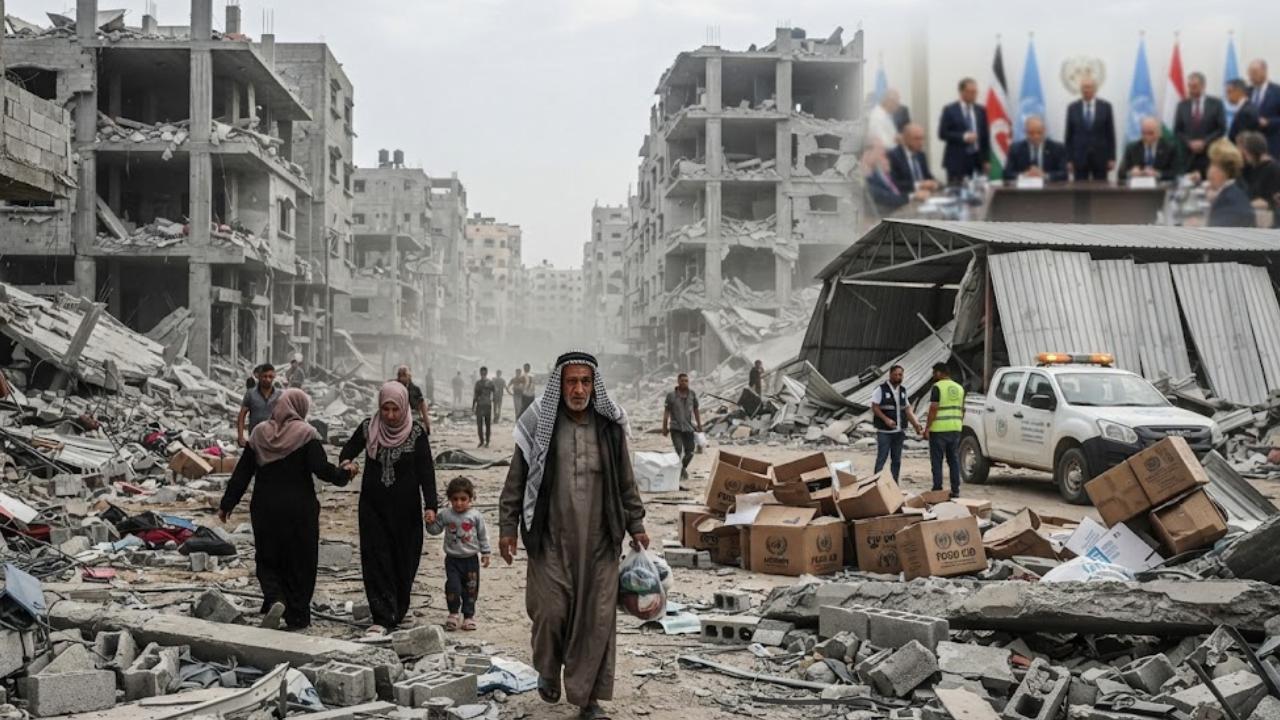
Three Palestinians were killed in separate Israeli attacks across Gaza on Thursday, among them a man sheltering in a displacement tent. The deaths came just hours after the United Nations’ top envoy for the territory warned the Security Council that the fragile truce is edging toward what he called a Gaza ceasefire point of no return.
Nickolay Mladenov, high representative for Gaza on the US-backed Board of Peace, delivered the warning during a briefing on Wednesday. He told diplomats that a collapse of the ten-month-old agreement would leave the enclave with no framework left to salvage.
A Warning Delivered to the Security Council
Mladenov’s message to diplomats in New York was blunt: the ceasefire is technically holding, but it is not yet reaching the people it was meant to protect.
He told the council that fatalities have declined sharply since the US-brokered agreement took hold last October, yet acknowledged that Palestinian civilians are still being buried under it. “A ceasefire under which civilians are still buried is not yet one the people of Gaza can feel,” he said.
He went further, describing what renewed full-scale war would mean for a territory already stripped of nearly everything: “Gaza does not have another catastrophe left in it.”
The envoy’s language around the Gaza ceasefire point of no return was deliberate. Should fighting resume in earnest, he argued, there would be no political roadmap left to fall back on, no transitional administration ready to take over civilian governance, and no infrastructure remaining to rebuild upon. He framed a second collapse not as a temporary setback but as something closer to permanent — the end of any credible path toward reconstruction, as Al Jazeera reported from the Security Council session.
Behind the diplomatic language sits a stalled mechanism. Hamas and other Palestinian factions agreed on July 30 to surrender their weapons and hand civilian and security authority to a transitional Palestinian administration recognized by the UN. An International Stabilization Force under US Major General Jasper Jeffers is meant to eventually deploy to oversee demilitarization.
Ten months on, that handover has not happened. Mladenov told the council Israel had reaffirmed its commitments under the broader 20-point framework but that, in his words, “important questions of implementation still remain open” – a diplomatic way of noting that Israel has not fully honored obligations tied to scaling back military operations and expanding humanitarian access.
At the same session, Athena Rayburn of the Association of International Development Agencies went further, telling the council that the new Board of Peace structures had effectively subordinated Palestinian rights to what she called the arbitrary demands of the occupying power. The US ambassador to the UN, Mike Waltz, rejected the characterization as one-sided.
Strikes Continue Even as the Gaza Ceasefire Point of No Return Looms
While envoys debated sequencing in New York, Israeli drones were still active over Gaza. A correspondent for the Palestinian news agency WAFA reported that an Israeli drone struck a tent sheltering displaced families on al-Hayya Street in the al-Mawasi area of western Khan Younis on Thursday.
The strike killed Azzam Refaat al-Abadleh and wounded several others nearby. A second drone strike, this one targeting an electric bicycle near the al-Sinaa intersection west of Gaza City, killed one man and left several people wounded, one of them critically. A third strike hit a tent near the Ansar intersection, also west of Gaza City, killing another Palestinian and injuring several more people, including a child.
None of the three strikes coincided with active combat. All three hit people either sheltering in makeshift tents or moving through residential streets – the same category of civilian infrastructure previously hit in a strike on a Gaza desalination plant earlier this month. Medics who treated the wounded, including staff connected to hospitals like those covered in our report on the Nasser Hospital anniversary, say the pattern is now familiar in Gaza: strikes that Israel’s military generally describes, when it comments at all, as targeting militants or “terrorist infrastructure,” landing instead in spaces where displaced families have been living for months because they have nowhere else to go.
The strikes came the same day Israel’s defense minister, Israel Katz, renewed a threat to forcibly evacuate Palestinians from any part of Gaza where children were seen flying kites – a practice Israeli officials have periodically cast as a security threat despite its being, for most families in the tent camps, one of the only remaining forms of recreation available to their children.
What This Story Reveals
News organizations covering Gaza tend to lead with the political drama at the UN or with aggregate casualty counts. What gets lost is that the ceasefire, on any given day, is being tested not by battlefield offensives but by strikes on the most exposed people in the territory.
These are people with no walls between themselves and a drone, living in tents because their homes no longer exist. Al-Abadleh’s death on al-Hayya Street will not alter the trajectory of talks in New York. It will not appear in most wire summaries beyond a single line.
But it is precisely this kind of death – anonymous to the outside world, devastating to the people who knew him – that Mladenov seemed to be gesturing toward when he said the ceasefire has not yet become something Gaza’s population can actually feel. It is another small marker on the road toward the Gaza ceasefire point of no return that diplomats are now openly discussing.
Casualties Since the Truce
According to Gaza’s Health Ministry, whose figures the United Nations considers reliable, at least 1,303 Palestinians – including roughly 300 children – have been killed in Israeli attacks since the ceasefire nominally took effect in October, with more than 4,000 others wounded.
Israel’s military has reported five of its soldiers killed by Palestinian attackers over the same period, along with one civilian contractor. Those figures sit atop a far larger toll from the war that began after the October 7, 2023, Hamas-led attack on southern Israel, which killed about 1,200 people and saw roughly 250 taken captive.
More than 73,400 Palestinians have been killed and over 174,000 injured in the two years of Israeli military operations that followed, according to the same ministry.
Current Status
As of Thursday, the transitional governance plan remains stalled. Hamas has not disarmed on the timeline Washington and the Board of Peace had hoped for, and Israeli strikes – some described by Israel as responses to ceasefire violations, others left unexplained – continue on a near-daily basis.
Committees that Mladenov said had been established with Israel to resolve outstanding disputes have not produced visible results, and the International Stabilization Force has yet to deploy. Diplomats say the coming weeks, as the Board of Peace convenes further sessions, will determine whether the framework advances toward the disarmament and governance handover it was designed to deliver – or whether it drifts toward the Gaza ceasefire point of no return that Mladenov says Gaza cannot survive.
This is a developing situation. Details on the individual strikes, including precise casualty figures, remain preliminary and subject to revision as hospitals and local sources continue reporting.