One year has passed since the world watched footage of a “double-tap” strike tear through Nasser Hospital in Khan Younis, and the families of the Nasser Hospital journalists killed in that attack are still waiting for a single clear answer. No officer has been named. No court has ruled. No formal accountability has followed – only a one-line description from Israeli officials calling it a “tragic mishap.”
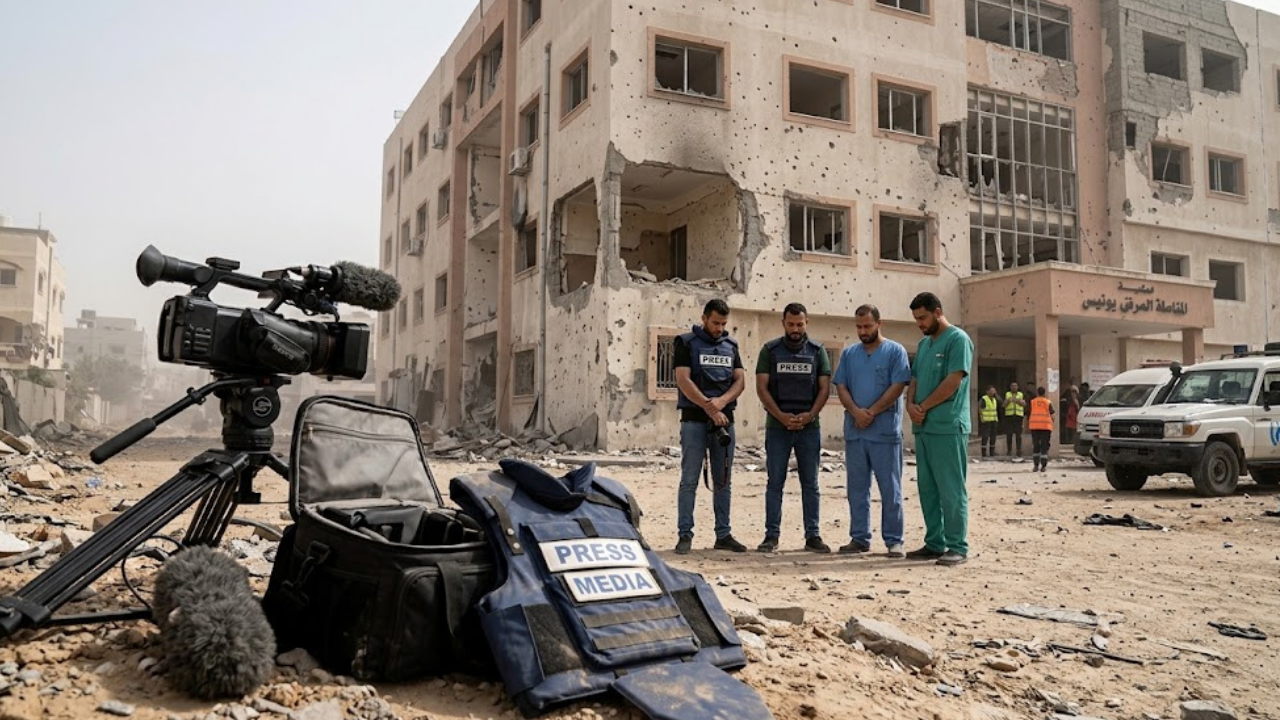
On August 25, 2025, two Israeli strikes hit the hospital compound within minutes of each other. The first hit the fourth floor, where surgical units and doctors’ quarters are located. The second struck a stairwell and balcony area that journalists regularly used to film and broadcast live from Khan Younis – a location rescuers and reporters had rushed to after the first blast. In total, 22 people were killed, including five journalists and several first responders and medical workers, with more than 50 others wounded.
Who Were the Journalists Killed at Nasser Hospital
The five media workers killed in the attack were:
- Hussam al-Masri — a Reuters contractor and cameraman
- Mariam Dagga — a freelance visual journalist who had worked with the Associated Press and other outlets throughout the war, and had recently reported on children suffering from starvation at the same hospital
- Mohammad Salama — an Al Jazeera cameraman
- Moath Abu Taha — a freelance journalist
- Ahmed Abu Aziz — a freelance journalist
A member of Gaza’s Civil Defense crew also died in the second strike, along with hospital staff who had gone to help the wounded from the first attack.
Why the “Double-Tap” Strike Drew International Condemnation
The Nasser Hospital journalists killed in this attack were struck in what press freedom groups and news organizations describe as a textbook double-tap pattern: one strike, then a second aimed at the people who came to help the injured. Rights groups have argued that deliberately targeting rescuers and first responders after an initial strike constitutes a war crime under international humanitarian law.
Reuters and the Associated Press have jointly called on Israel to release a full, transparent account of why the strikes happened, and why a camera operator who was known to the military as a working journalist was not identified before the first strike was ordered. The Committee to Protect Journalists has separately urged Israeli authorities to conduct a prompt and independent investigation, warning that a lack of accountability makes it more dangerous for journalists to document conflict zones and undermines the public’s right to know what is happening on the ground.
Video captured from the scene shows the moment the second strike hit, sending journalists and medics running for cover through smoke and debris – footage that has since become one of the defining images of the risks facing the press corps covering the war in Gaza.
One Year Later: Still No Accountability
A year on, Israeli officials maintain that the initial target was a suspected Hamas camera mounted on the hospital roof. But despite repeated requests from AP, Reuters, and press freedom organizations, the Israeli military has not released details of its internal investigation, nor offered a timeline for when – or whether – it will be completed.
This pattern is not unique to Nasser Hospital. Press freedom monitors say Israel has rarely held its own troops accountable for the deaths of Palestinian civilians during the war, pointing to a long history of internal investigations that stretch on for months or years without leading to disciplinary action or prosecution. Journalist advocacy groups now count more than 270 media workers killed in Gaza since the war began in October 2023, making it one of the deadliest conflicts for press freedom in modern history.
Families of the victims have kept the memory of their loved ones alive in the absence of official answers. Mariam Dagga’s father has publicly displayed her blood-stained camera and phone – the equipment she carried into Nasser Hospital on the day she died – as a quiet, physical protest against the silence that has followed.
A Broader Pattern of Humanitarian Crisis
The killing of the Nasser Hospital journalists killed while covering a war zone reflects a wider collapse in humanitarian protections that has defined crises well beyond Gaza. From displaced families in Sudan, where children remain out of school amid ongoing conflict, to the strain of global youth unemployment deepening instability in fragile regions, 2025 and 2026 have repeatedly shown how quickly civilian protections can erode when accountability mechanisms fail.
Diplomatic efforts tied to the region, including discussions around a Gaza stabilization force involving Uganda and Burundi and the broader debate over Zelensky’s peace plan for a different but related global conflict, underline how international attention on accountability and civilian protection remains fractured and slow-moving, even as press freedom organizations continue pushing for answers on cases like Nasser Hospital.
What Comes Next
Press freedom groups say the anniversary of the strike should renew pressure on Israel to:
- Publish the full findings of its internal investigation into the strikes
- Explain why journalists on the hospital balcony were not identified before the first strike
- Grant international journalists access to Gaza to independently verify conditions on the ground
- Commit to concrete accountability measures, rather than internal reviews that rarely result in prosecution
Until then, the case of the Nasser Hospital journalists killed stands as one more entry in a growing list of unresolved attacks on media workers – a reminder that without independent investigation and consequences, the risks faced by journalists covering war zones will only continue to grow. Sources: Associated Press, Al Jazeera